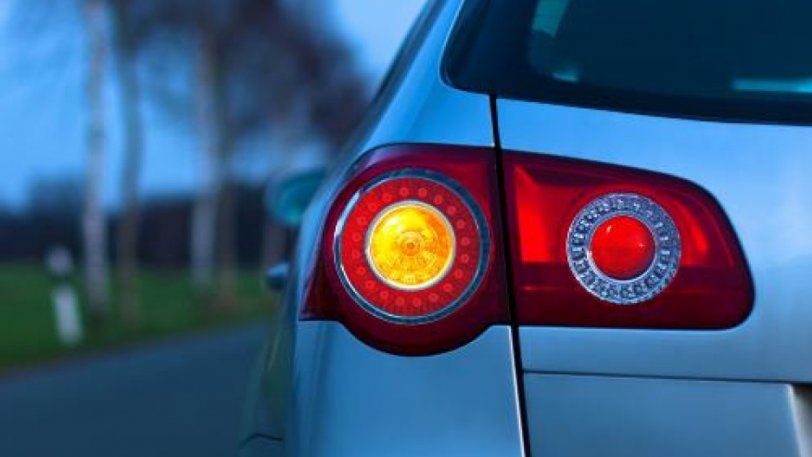
USE OF DIRECTION INDICATORS (FLASH) EMERGENCY LIGHTS (ALARM) AND SOUND WARNING (HORN or HORN)
EMERGENCY LIGHTS
Emergency lights are used to warn other road users that an emergency and dangerous situation is ahead.
Conditions for using the emergency lights are as follows:
1- When there is a breakdown in the vehicle and is stationary on any road whether or not it obstructs other road users.
2- When the vehicle is moving at reduced speed due to damage (and not because we relax or are lazy) not only on a road that develops high speeds, but on any road. Be careful if this action endangers the lives of other road users you will not do it
3- When we drive on roads outside cities and there are conditions of low visibility (evening-fog etc.) and heavy traffic and suddenly the traffic slows down e.g. driving on the freeway at night with your lights on and you are last in the line of cars going at a normal speed, suddenly the vehicles in front slow down for some reason, you who are last should activate the alarms immediately by applying the brakes because the people coming behind may not notice that the brake lights are on because of your slowing down, remember that you already have your side lights on (red).
4- When you have parked or stopped (sometimes I stop it and sometimes I park it) somewhere and you need to be visible to other road users, e.g. pick up or deliver passengers or luggage or for any other justifiable reason and you will obstruct any traffic
5- When we have stopped to make it easier for pedestrians to cross the road together with the left hand in a bent position towards the road.
STRICT NOTE: We do not activate the ALARMS in cases where we park or make any maneuver (see details below). We use the direction indicators, depending on which direction we are maneuvering. ATTENTION it is a big and stupid mistake to use emergency lights for any maneuver and especially for parking. The reason most people use ALARMS is because most of us don't know we should be using turn signals, let's start doing the right thing
HORN-HORN
The audible warning (horn or horn) can be used in the following cases:
1- When driven outside residential areas in any case in order to avoid an accident or overtake
2- Within residential areas areas only when you are going to avoid an accident, when overtaking or detouring, flash your high beam (day or night).
3- You don't honk when to pedestrians and animals even if they have blocked your path, you will wait patiently for them to leave in front of you and especially when you are driving on a pedestrian street where no vehicles are allowed to move.
4- You don't honk for short-jumping at intersections (within residential areas) justifying to yourself that you are doing it to avoid the accident. At intersections you are supposed to use up all your control and then honk your horn.
5- You don't honk when you rush to force other road users to make way for you e.g. traffic lights, STOP and intersections when the other person is late checking or leaving
6- In general, don't honk your horn for no reason
The horn can be replaced by pressing the throttle in-out and pressing the clutch to hear the engine running
It is possible that the above cases are not the only ones and I am missing some others. The point for drivers, however, is to exercise their own judgment and not have someone remind them, so think when you're driving or when you're co-driving
DIRECTION SIGNALS
RIGHT or LEFT corner
You put out a right turn signal for a right corner and a left turn signal for a left turn, and here you have to make sure the turn signal is on until you get a call to the curb you're going to enter, right? the others apply as we said in the use of the flashes
Turn left or right on the spot
Left
We flash right to stop on the right sidewalk (almost touching) and after checking for oncoming vehicles we flash left to move to the opposite sidewalk (left), from now on it is not necessary for the flash to work, but if you wish, turn it on again. You will back up so that the rear wheels touch the right curb and there you flash (left) to continue your course, after checking for oncoming vehicles. The opposite actions must be taken for a right turn on the spot
4- When we want to overtake. The turn signal must remain on throughout the overtaking even if you are overtaking a line of cars. You will only turn it off when you are overtaking and there are intersections in front of you (e.g. within the city), because in this case confusion and panic is created for other road users. They think you will turn
You will also turn off the flash when driving in the middle or left lane (for no reason and without overtaking, i.e. you are breaking the law), in order for someone from behind to warn you by honking or with their lights.
5- When we want to tell the back , to overtake us - flash right for overtaking from the left and flash left for overtaking from the right. Caution before giving approval to the rear, move your vehicle to the correct position and make sure that no one is coming from the opposite direction, resulting in an accident.
6- When we want to say in the back not to overtake us because something strange is happening in front of us, we turn on the left turn signal and turn it off slowly and progressively
7- When we want to stop for any reason e.g. to load or unload luggage or passengers, to stop to make a phone call, etc. in combination with the alarms ATTENTION !!! but when do we flash and when do we sound the alarm: 10 m before the point where we want to stop we flash left or right depending on which side we want to stop and 2 m before the complete standstill we sound the alarms so that those following us understand our intentions.
RIGHT or LEFT corner
You put out a right turn signal for a right corner and a left turn signal for a left turn, and here you have to make sure the turn signal is on until you get a call to the curb you're going to enter, right? the others apply as we said in the use of the flashes
Turn left or right on the spot
Left
We flash right to stop on the right sidewalk (almost touching) and after checking for oncoming vehicles we flash left to move to the opposite sidewalk (left), from now on it is not necessary for the flash to work, but if you wish, turn it on again. You will back up so that the rear wheels touch the right curb and there you flash (left) to continue your course, after checking for oncoming vehicles. The opposite actions must be taken for a right turn on the spot
4- When we want to overtake. The turn signal must remain on throughout the overtaking even if you are overtaking a line of cars. You will only turn it off when you are overtaking and there are intersections in front of you (e.g. within the city), because in this case confusion and panic is created for other road users. They think you will turn
You will also turn off the flash when driving in the middle or left lane (for no reason and without overtaking, i.e. you are breaking the law), in order for someone from behind to warn you by honking or with their lights.
5- When we want to tell the back , to overtake us - flash right for overtaking from the left and flash left for overtaking from the right. Caution before giving approval to the rear, move your vehicle to the correct position and make sure that no one is coming from the opposite direction, resulting in an accident.
6- When we want to say in the back not to overtake us because something strange is happening in front of us, we turn on the left turn signal and turn it off slowly and progressively
7- When we want to stop for any reason e.g. to load or unload luggage or passengers, to stop to make a phone call, etc. in combination with the alarms ATTENTION !!! but when do we flash and when do we sound the alarm: 10 m before the point where we want to stop we flash left or right depending on which side we want to stop and 2 m before the complete standstill we sound the alarms so that those following us understand our intentions.
Cookie settings
We use necessary cookies for the operation of the website and, with your consent, statistics cookies to improve your experience. Cookie Policy
Cookie preferences
You can change your choice at any time from the Cookies Policy.