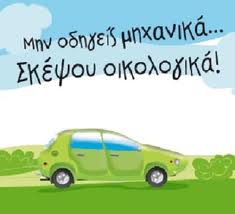
ECOLOGICAL DRIVING has entered our lives in one way or another: New drivers in all European countries will need to take tests in the near future that will confirm their ability to drive not only correctly and safely but also... ecologically (Eco-Driving)! That is, drivers should learn to drive in such a way as to save fuel, reducing their consumption by up to 1/3, a practice that can prove to be beneficial both for the environment and for their pocket...
What a driver needs to follow in order for his driving to be ecological and economical is simple and rather easily applied, which is why we present you our opinions and our experience on this matter.
Our school teaches you some things that are contrary to ecological driving, this is because we attach great importance to safe driving, as new drivers that you are, however when your training progresses we will also do some ECO DRIVING lessons.
1=32! A car moving with its engine at 4,000 rpm emits as much noise as 32 cars moving at the same speed but at 2,000 rpm
What is Eco-Driving
It is a program that describes an intelligent way of driving in which drivers, taking advantage of the potential of the new engines, will be able to reduce:
Fuel consumption.
- The cost of maintaining and repairing their car.
- The noise pollution.
- Emissions of exhaust gases and greenhouse gases.
- Traffic accidents.
- Anxiety while driving.
This program is already implemented or will soon be implemented in the Netherlands, Spain, Austria, Finland, Germany and the UK.
And what is happening in our country? In our country, the program exists only in written and oral forms, but soon it will also be included in the minutes. Our faculty provides this kind of education in Theory and practical courses.
A LITTLE THEORY ABOUT ECOLOGICAL DRIVING
What do conservationists-guides do?
There are several smart ways to help the environment and our pocket.
Let's see what we can do: - Check the tire pressure at least once a month. The check is necessary because, when the tire pressure is too low, the tire's resistance to friction with the road surface increases, with the consequence that fuel consumption also increases (with 0.5 bar less pressure than prescribed, fuel consumption increases by 4%). Also, driving with low tire pressure is dangerous because of the unwanted effects on the car's traction and braking. As a general rule, the tire pressure should be checked with relatively "cold" tires (before measuring the pressure, we should have driven less than 3 km or else wait for about 10 minutes for the tires to cool down).
- Let's "take advantage" of the possibilities offered by devices such as economizers, electronic trip computers, cruise control systems, as well as speed and speed limiters, which help save fuel and often even increase road safety.
DRIVE WITH TACHOMETER RUNNING BETWEEN 1500-3000 RPM - We change gear as quickly as possible, since when we drive at low revs, fuel losses are limited and the efficiency of our car increases. Your instructor will inform you of this
- Drive at a constant speed and avoid unnecessary acceleration and braking, as this significantly reduces fuel consumption. The presence in our car of a constant speed maintenance system ("cruise control") can help decisively in smooth driving at a constant speed.
- Let's observe as far ahead as we can, so that we can act appropriately and in time. The goal is to drive at a constant speed and avoid unnecessary braking and acceleration.
- Let's slow down the car smoothly, leaving the gas in time and at the same time having selected a certain gear, when we need to reduce speed or stop. In this way, the wear and tear of the brakes and tires is also reduced and therefore the maintenance costs of the car are reduced. Also, pollutant emissions are reduced, vehicle traffic flow, safety and passenger comfort are improved.
- Turn off the car engine when you need to stop the car for 1 minute or more. Of course, older cars sometimes consume an additional amount of fuel when the engine starts, so the benefits are less, for new ones there is no problem.
- Do not step on the accelerator when starting the car engine, as was necessary in older cars.
- Do not reduce speed by braking rather than by changing gears.
- Let's empty our car of unnecessary weights (e.g. heavy objects in the trunk or on the back seats, such as boxes with snow chains, etc.). The most important factor affecting the average fuel consumption of a car is its weight. Suffice it to say that a mid-range car weighing 1,500 kg with an extra load of 100 kg consumes about 6.7% more fuel.
- We should remove from our car anything that affects its aerodynamic behavior (air vents, grills or roof racks, additional large antennas, etc.), but also avoid driving with the windows open. After all, the second most important factor affecting fuel consumption (after weight) is the car's aerodynamic resistance. Every additional part or accessory fitted to the base vehicle causes a large increase in its aerodynamic drag and therefore a large increase in fuel consumption.
- Do not put the air conditioner at a temperature below 25° C, since it has been calculated that, especially when there is traffic congestion, fuel consumption increases by 20%. Nevertheless, if we are in a dilemma between whether we should open the window or put on the air conditioner (on routes outside the city at a speed of more than 80 km/h), it is important to know that using the air conditioning leads to less additional fuel consumption compared to the additional amount of fuel required if we open a window (due to the increase in aerodynamic resistance). In general, however, with the use of the air conditioner, fuel consumption increases by 10% on average.
GOOD LUCK & GOOD FINANCIAL & ENVIRONMENTAL BENEFITS